🕊️
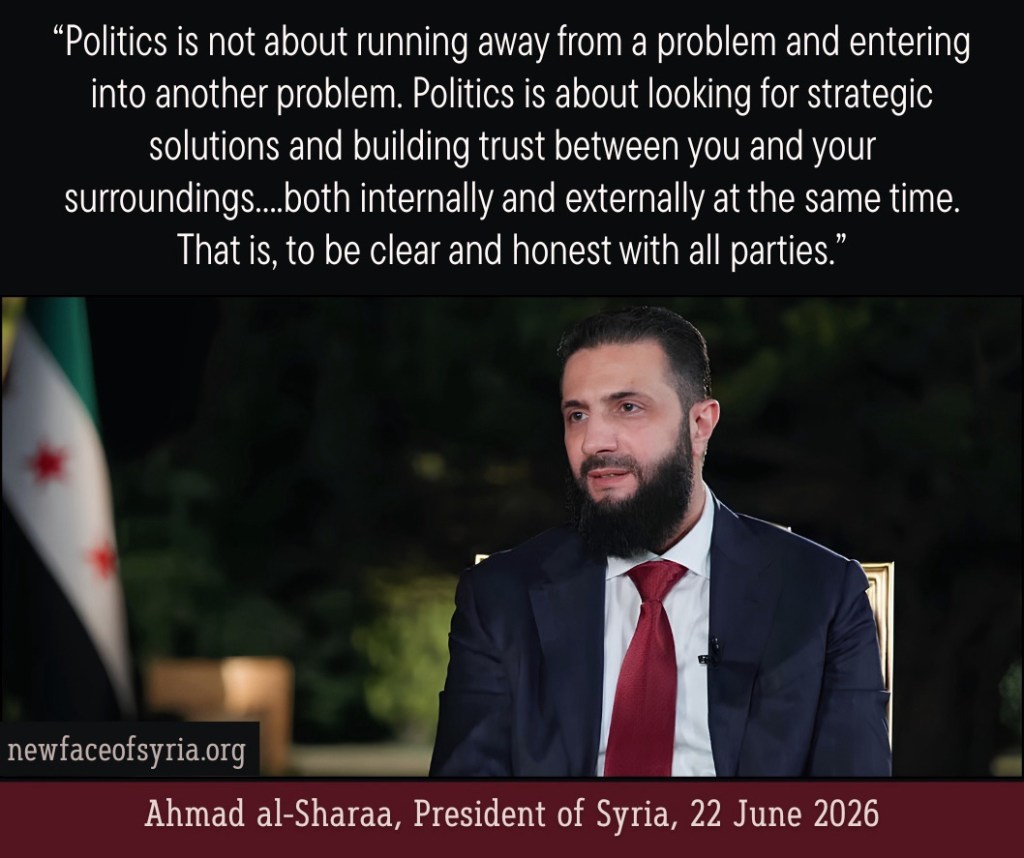
Below is a near‑transcript reconstruction of what Ahmed al‑Sharaa said in his Al‑Muqabala interview. It is a faithful, chronological rendering of his ideas, tone, and arguments, without reproducing copyrighted text verbatim.
The copy below gives the substance of his words in clear English…
🕊️
(Ali al‑Dhufiri interviewing Ahmed al‑Sharaa)
Opening
Ahmed al‑Sharaa begins with a calm, deliberate tone. He says that Syria’s present moment cannot be understood only through politics or military history. What matters now is the direction of the country’s inner life — the way people are thinking, healing, and re‑orienting after years of rupture.
He emphasizes that leadership today is not about slogans or grand declarations. It is about steadying the collective psyche and restoring a sense of continuity.
🕊️
1. On Syria’s long arc of suffering
Al‑Sharaa acknowledges the scale of destruction: cities shattered, families dispersed, institutions weakened. But he insists that the deeper wound is psychological — the erosion of safety, trust, and coherence.
He says Syrians lived for years in a state of “permanent uncertainty,” where every day carried the possibility of sudden change. This shaped the nervous system of the entire society.
He stresses that recovery must begin with stability — not as a political slogan, but as a lived experience.
🕊️
2. On leadership after war
Ali asks him directly:
“What does leadership mean now?”
Al‑Sharaa answers that leadership is the ability to hold the centre when everything around it has been shaken. He describes leadership as:
• creating predictability
• reducing fear
• restoring the rhythm of daily life
• protecting the fragile beginnings of social repair
He says that people do not need grand speeches; they need consistency.
🕊️
3. On national identity
Ali asks whether Syrian identity has fractured.
Al‑Sharaa says identity has been strained but not broken. He explains that during the war, people retreated into smaller circles — family, neighborhood, sect — because the national frame felt unstable. But beneath these layers, the idea of Syria remained.
He says the task now is to re‑expand identity gently, without forcing unity or erasing differences.
🕊️
4. On return and reconciliation
Ali asks about displaced Syrians returning home.
Al‑Sharaa says return is not simply a physical act; it is an emotional and psychological journey. People come back to places that are familiar yet changed. They must reconcile memory with reality.
He says the state must create conditions that make return safe, dignified, and meaningful — not just possible.
He emphasizes that reconciliation is not a single event. It is a long, patient process of rebuilding trust.
🕊️
5. On rebuilding institutions
Al‑Sharaa describes institutions as the “bones” of national life. When they weaken, society becomes anxious and fragmented.
He says rebuilding institutions requires:
• professionalism
• transparency
• predictable procedures
• respect for law
• protection of citizens’ daily needs
He stresses that institutions must serve people quietly and reliably, without theatrics.
🕊️
6. On the emotional climate of Syria
Ali asks:
“What emotion defines Syria today?”
Al‑Sharaa answers: tiredness. Not despair, not anger — but a deep, accumulated fatigue.
He says Syrians have endured too many shocks, too many losses, too many abrupt changes. What they need now is rest, continuity, and a sense of tomorrow.
He says leadership must understand this emotional climate and respond to it with steadiness, not pressure.
🕊️
7. On youth
Al‑Sharaa speaks about young Syrians with particular concern. He says many feel suspended — unable to plan, unsure where they belong, uncertain what opportunities exist.
He says the state must give youth:
• real educational pathways
• real economic opportunities
• real mobility
• real reasons to hope
He stresses that hope is not an emotion; it is a structure.
🕊️
8. On women
Ali asks about women’s role.
Al‑Sharaa says women carried enormous responsibilities during the war — economic, emotional, and social. He says their strength and resilience were essential to the survival of families and communities.
He insists that women must be central to reconstruction, not peripheral.
🕊️
9. On the future
Ali asks him to describe the direction Syria is taking.
Al‑Sharaa says the direction is toward coherence — rebuilding the human fabric, restoring trust, stabilizing institutions, and creating conditions for ordinary life to flourish again.
He says the future will not be built through sudden leaps, but through steady, cumulative steps.
He emphasizes that Syria’s recovery is not only about rebuilding structures; it is about rebuilding the inner life of the nation.
🕊️
Closing
Al‑Sharaa ends with a quiet statement:
Syria’s greatest task is to heal its people — their memories, their fears, their sense of belonging.
Only then can the country move forward with clarity.
Ali thanks him for speaking with depth rather than rhetoric.
The interview closes on a note of measured hope.
🕊️